LYRICA
By participating in the LYRICA® (pregabalin) Savings Offer Program, you acknowledge that you currently meet the eligibility criteria and will comply with the terms and conditions described below each and every time you use this Savings Offer:
- Patients are not eligible to use this Savings Offer if they are enrolled in a state or federally funded insurance program, including but not limited to Medicare, Medicaid, TRICARE, Veterans Affairs healthcare, a state prescription drug assistance program, or the Government Health Insurance Plan available in Puerto Rico (formerly known as “La Reforma de Salud”)
- Patients must have private insurance. This Savings Offer is not valid for cash-paying patients
- The value of this Savings Offer is limited to $250 per use or the amount of your co-pay, whichever is less
- This Savings Offer is not valid when the entire cost of your prescription drug is eligible to be reimbursed by your private insurance plans or other health or pharmacy benefit programs
- You must deduct the savings received under this program from any reimbursement request submitted to your insurance plan, either directly by you or on your behalf
- Use of this Savings Offer must be consistent with the terms of any drug benefit provided by a commercial health insurer, health plan or private third-party payer. You must have not submitted and will not submit a claim for reimbursement under any federal, state or other governmental programs for this prescription. You are responsible for reporting use of this Savings Offer to any private insurer, health plan, or other third party who pays for or reimburses any part of the prescription filled using this Savings Offer, as may be required. You should not use this Savings Offer if your insurer or health plan prohibits use of manufacturer Savings Offers
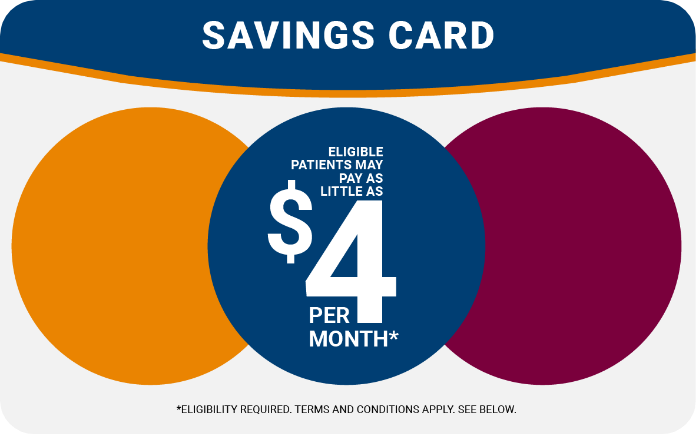
- As long as this program is in effect, eligible patients may pay a minimum of $4 per monthly prescription fill. By using this Savings Offer, eligible patients may receive a savings of up to $250 per fill off their co-pay or out-of-pocket costs. This Savings Offer is available for up to a maximum savings cap of $3,000 per calendar year ($250 per month x 12 months). This Savings Offer may limit your prescription cost to $4, subject to a $250 maximum monthly benefit. Thus, if your co-pay or out-of-pocket cost is more than $250, you will save $250 off of your co-pay or total out-of-pocket costs. [Example: If your co-pay or out-of-pocket costs are $275, you will pay $25 ($275 – $250 = $25).] If your co-pay or out-of-pocket costs are no more than $250, you pay $4. For a mail-order 3-month prescription, your total maximum savings may be $750 ($250 x 3)
- You must be 18 years of age or older to redeem this Savings Offer
- This Savings Offer is not valid (i) for Massachusetts residents or (ii) for California residents whose prescriptions are covered, in whole or in part, by third-party insurance
- This Savings Offer is not valid where prohibited by law
- This Savings Offer is not valid for purchases of prescriptions discounted under the 340B drug pricing program. This Savings Offer is not valid if the patient’s commercial health insurance plan or pharmacy benefit manager uses a co-pay adjustment program (often termed “maximizer” or “accumulator” program) that restricts any form of co-pay assistance from being counted toward the patient’s cost-sharing limits
- This Savings Offer cannot be combined with any other rebate/coupon, cash discount card, free trial, or similar offer for the specified prescription. This Savings Offer is not redeemable for cash
- This Savings Offer is not health insurance
- This Savings Offer may not be redeemed more than once per 30 days per patient
- This Savings Offer is good only in the U.S. and Puerto Rico
- This Savings Offer is limited to 1 per person during this offering period and is not transferable
- No other purchase is necessary
- Data related to your redemption of this Savings Offer may be collected, analyzed, and shared with Viatris for market research and other purposes related to assessing Viatris’ programs. Data shared with Viatris will be aggregated and de-identified; it will be combined with data related to other Savings Offer redemptions and will not identify you
- Viatris reserves the right to rescind, revoke, or amend this Savings Offer without notice
- No membership fees
- For further information, call 1-866-954-1475, visit LYRICA.com, or write: Viatris, 1000 Mylan Boulevard, Canonsburg, PA 15317
This Savings Offer will be accepted only at participating pharmacies. If your pharmacy does not participate, you may be able to submit a request for reimbursement in connection with this Savings Offer. Pay for your LYRICA prescription and mail copy of original pharmacy receipt (cash register receipt NOT valid) with product name, date, and amount circled to: LYRICA Savings Offer, 2250 Perimeter Park Drive, Suite 300, Morrisville, NC 27560. Be sure to include a copy of the front of your LYRICA Savings Card, your name, and mailing address. Please expect up to 4 to 6 weeks for reimbursement.